
In Kyoto today there are still hanamachi — entertainment districts where the culture of the maiko and geiko lives on. Kamishichiken, Gion Kobu, Gion Higashi, Pontocho and Miyagawacho: these five districts belong to the Kyoto Hanamachi Federation and are known together as the “Five Hanamachi of Kyoto.” Our own studio, KOKORO HANASHIZUKU, is in Miyagawacho, one of these five.
Once, however, Kyoto held another hanamachi, distinct from these five. That was Shimabara — the district where the tayu, regarded as the highest rank a woman could hold, flourished.
What kind of place was Shimabara?
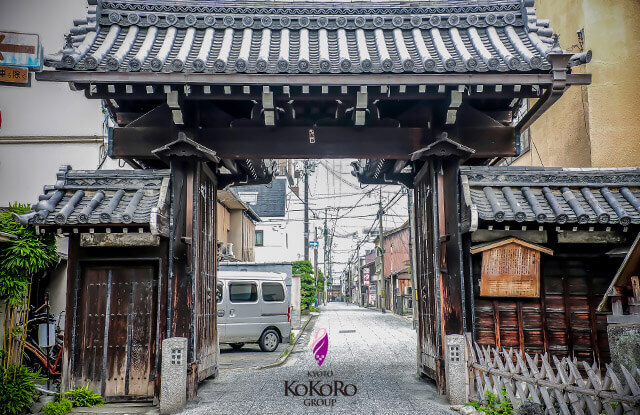
The formal name of Shimabara was Nishi-Shin’yashiki. Lying to the northwest of Kyoto Station, it prospered in the Edo period as an officially licensed quarter and hanamachi. Until 1976 it belonged to the Kyoto Hanamachi Federation, and it was a district with a formality and a culture all its own, distinct from Gion.
What is especially worth noting is that Shimabara was a hanamachi of high standing, one that received imperial family members, court nobles and aristocrats. Those who flourished there were the tayu — held, in their day, to be the highest rank a woman could attain. Accomplished in waka poetry, calligraphy, tea ceremony, dance and every kind of art, and possessed of both learning and grace, the tayu stood at the very summit of the performing arts.
And the tradition of the tayu has been carried on, unbroken, to this day. The institution of the tayu still survives, though their number is only a few — some four or five. Shimabara has become an irreplaceable place, one that carries the precious culture of the tayu into the present.
The origin of the name Shimabara
There are several theories about the origin of the name Shimabara, but the one most often favoured is that the district was named because the commotion of its repeated relocations recalled the Shimabara Rebellion. As the name suggests, Shimabara was by no means a district whose history was one of tranquillity alone.
Three historic sites that remain in Shimabara
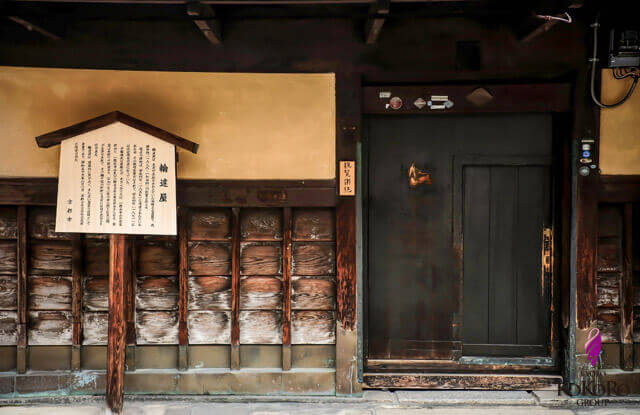
In Shimabara today, places that convey the character of those times have been carefully preserved.
Shimabara Ohmon (the Great Gate)
Built as the main gate of Shimabara, the Shimabara Ohmon faced onto Hanayacho Street and formed the entrance to the oldest officially licensed quarter in Japan. The whole of Shimabara was once surrounded by a moat, and it is said that one could enter or leave only by passing through this gate. This was a device both to keep order and to keep the women from leaving.
The present gate was built at the close of the Edo period, in Keio 3 (1867). To think that the loyalist activists of the late Edo period and the Shinsengumi once passed to and fro beneath it is to feel, inescapably, the weight of history.
Wachigaiya
The Wachigaiya is known as the only okiya in Japan that keeps tayu. It continues to operate today as both an okiya and a teahouse, and it carries the very heart of tayu culture. Its family crest uses the “wachigai” (interlocking-rings) design, and it has the distinctive feature of bamboo set on the roof of its second floor to guard against intruders.
Though normally closed to the public, it is said that within are preserved calligraphy by Katsura Kogoro, a folding screen made up from calligraphy by Kondo Isami of the Shinsengumi, tayu uchikake robes, and more. It is also said that Sakuragi Tayu, who belonged to the Wachigaiya, had a close relationship with Ito Hirobumi.
Sumiya
Sumiya was an ageya — an establishment that summoned tayu and geiko from the okiya to hold banquets accompanied by song and music. In present-day terms it corresponded to a fine restaurant or a ryotei. Today it is open to the public for limited periods as the Sumiya Museum of Hospitality (Sumiya Motenashi no Bijutsukan).
On display within are such things as a poem-card of a haiku by Matsuo Basho and a folding-screen painting by Yosa Buson, and in the inner “Matsu no Ma” (Room of the Pines) one can hear from a guide the anecdotes connected with the Shinsengumi. At the close of the Edo period it was also used as a place for secret talks by Kusaka Genzui, Saigo Takamori, Sakamoto Ryoma and others.
Shimabara today, and the tayu culture carried on
After the Meiji Restoration, demand for large-scale banquets declined, and with changes in its location as well, Shimabara lost the bustle it had once known. The centre of Kyoto’s hanamachi culture gradually shifted, too, toward Gion.
Yet the tayu culture of Shimabara did not come to an end. Even now, a few tayu carry on its art and its formality, taking the Wachigaiya as their base and displaying their graceful figures at banquets and festival occasions. Slowly, but surely, Shimabara goes on conveying the culture of the tayu into the present.
Shimabara is a precious district, one that shows us today in what kind of place, and in what manner, the tayu once lived. To savour the world of the tayu and the oiran more deeply, let your thoughts turn, if you will, to the history of Shimabara — the hanamachi of old.