
In English-language sources, oiran and tayu are usually placed under the same broad Western label.
The translation is not inaccurate, exactly. But it is incomplete, and it collapses two separate traditions into one.
Both were titles given to women at the very top of Japan’s licensed quarters during the Edo period (1603–1868). Beyond that, they had less in common than the shared label suggests.
Two different traditions
By the later Edo period, the oiran was the figure of Yoshiwara, in Edo — present-day Tokyo.
The tayu was the figure of Shimabara, in Kyoto.
The division was not always so clean. Earlier in the period, the title tayu was used in Yoshiwara as well, and in Osaka’s Shinmachi. In Edo it fell out of use, and the oiran took its place. But the two titles went on to develop separate identities, separate customs, separate worlds — and in Japan they have never been read as the same thing.
The tayu: a rank of the arts
The tayu is where the usual explanation breaks down most clearly.
Shimabara, licensed in the early Edo period, received members of the imperial family, court nobles, feudal lords, wealthy merchants and men of letters. To receive such guests, a woman needed more than beauty.
A tayu was expected to master waka poetry, calligraphy, tea ceremony, incense appreciation, dance and musical instruments. This was not an ornament to her position. It was the heart of it.
The title itself points to the standing associated with it. Tayu derives from a courtly term commonly used for holders of the fifth rank, and tradition describes a tayu as receiving treatment comparable to shogoi — the Senior Fifth Rank. The most accomplished among them are said to have performed before members of the imperial court.
The tayu was, in short, an artist of the highest rank. That artistic substance is central to how the tradition is understood, and preserved, even now.
None of which places her outside the world she lived in. The tayu belonged to the licensed quarters as surely as the oiran did, and to the constraints that came with them. It does explain, however, why a single word from another language leaves so much of her position unaccounted for.
What the oiran actually did
The oiran of Yoshiwara worked within a different structure, but the demands on her were not trivial.
She, too, was trained from childhood. Many entered the quarter as young girls, serving first as kamuro, the attendants of a senior woman. Classical literature, calligraphy, tea, poetry, the koto and shamisen, the game of go: these were expected of her.
She was also, in her time, a figure of fashion. Women across Edo copied her hairstyles, her makeup, the way she wore her robes. What began in the licensed quarter reached the wider city.
And she held, in principle, the right to refuse a guest. An oiran ranked above her patrons in the etiquette of Yoshiwara, and could decline a man she did not care for.
It should be said plainly, however, that this right was narrow in practice. It belonged only to a small number of women at the very top, and it operated within the strict rules of the quarter and conditions of work that were, by any measure, severe. To describe her as powerful would be as incomplete as the label we began with.
Why the distinction matters
The tayu tradition did not end.
A small number of tayu are affiliated today with the Wachigaiya in Kyoto’s Shimabara — an okiya founded in the Genroku era (1688–1704). Their art is performed at temples and shrines, at seasonal ceremonies, and in the tayu dochu, the slow processional walk that remains one of the most striking sights in Kyoto.
This is not a costume revived for visitors. It is a tradition that has been kept alive.
A figure still familiar in Japan

One thing that often surprises visitors: in Japan, the oiran is not an obscure historical footnote.
She appears in period films and television dramas. She appears on the kabuki stage. She appears in manga, in anime, in illustration and design. Not as a curiosity, but as a recognised symbol — shorthand for a particular kind of splendour.
Japanese audiences read her image much as Western audiences might read the imagery of Versailles: as a visual language of opulence, of artifice, of a beauty that belongs to another century.
This is the language we work in.
The aesthetics we recreate
What we offer at our studio is not a historical reenactment.
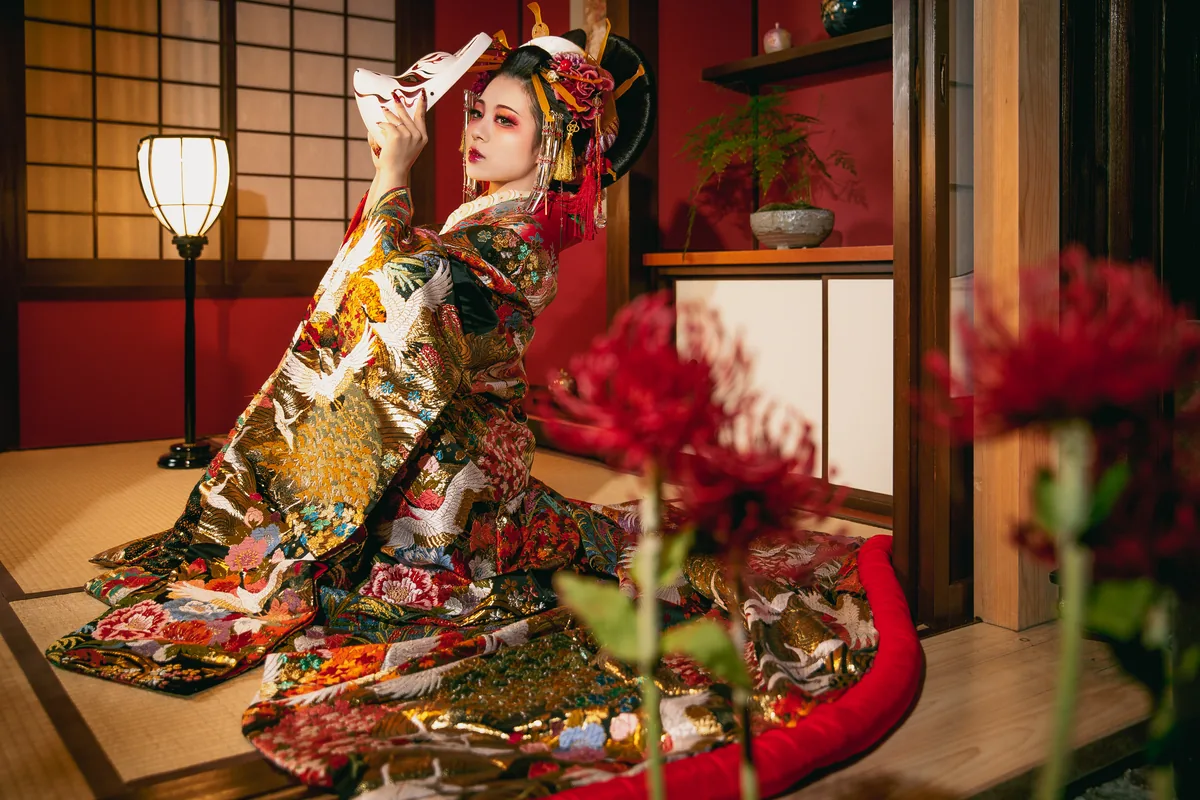
Our oiran experience does not aim to reproduce the life of a historical oiran. It draws on the visual culture that surrounded her — the magnificent uchikake robes, the ornaments, the sense of a world set apart from the everyday — and offers it as a photographic experience for visitors to Kyoto today.
We are aware that this history has many facets, some of them difficult. We do not ask our guests to carry the full weight of it. What we offer instead is a carefully created photographic experience drawn from its visual culture — and images they will want to keep.
The label you may have read online is not wrong. It is only small. Behind it stand two traditions, two cities, and a body of art that could take a lifetime to master.