
When one stands before a tayu, it is often her makeup that first holds the eye.
Vivid rouge against skin made smooth and white. In it lives an aesthetic distinct to Japan, one quite unlike modern cosmetics.
The makeup of the tayu was never mere ornament. It was one of the important preparations by which formality and tradition were expressed.
An aesthetic held at the nape — the two-line and the three-line
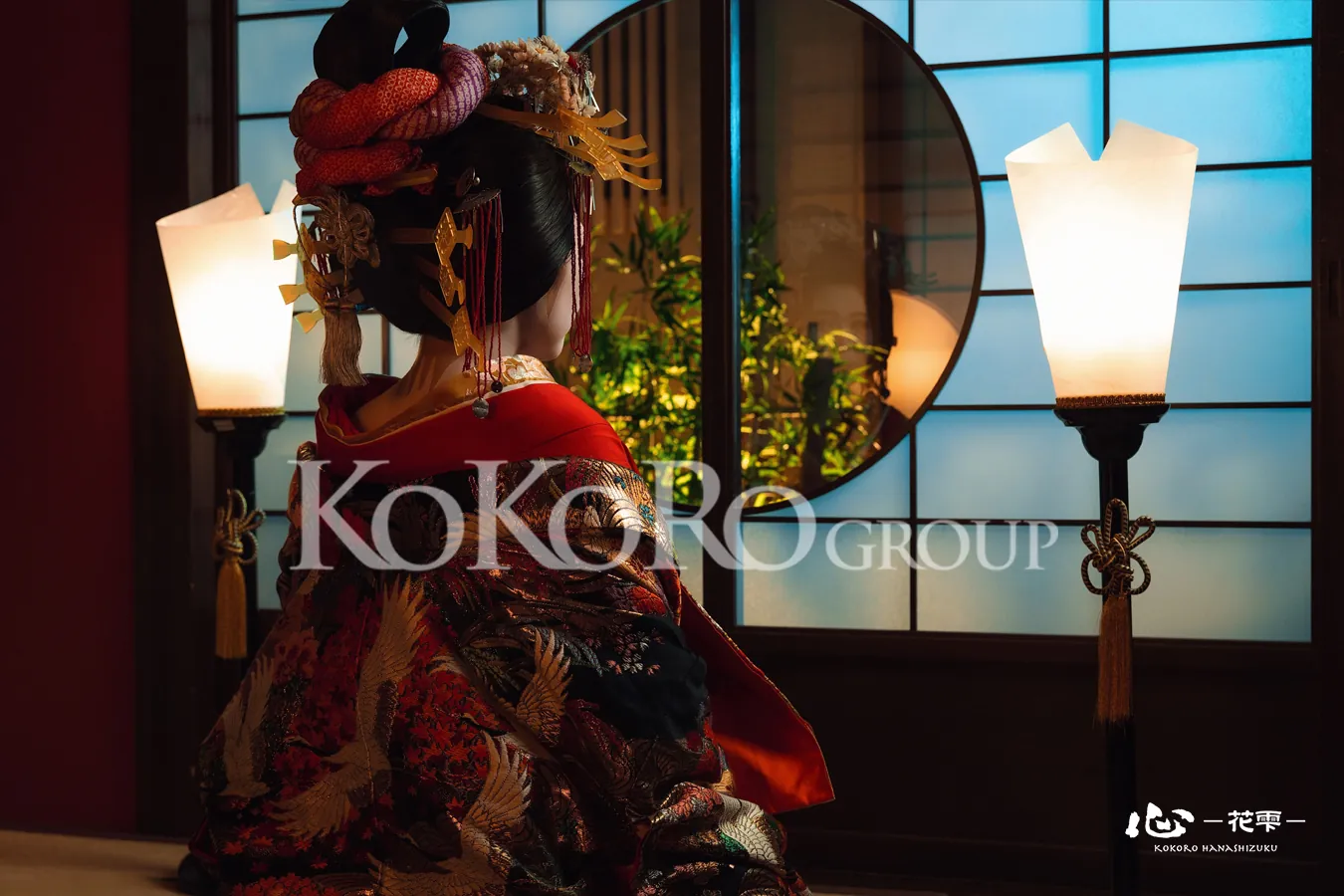
The single feature that most distinguishes the makeup of the tayu is the eriashi — the nape, the hairline at the back of the neck.
White makeup is applied from the face down over the neck. At the nape alone, however, a portion is deliberately left unpainted. That unpainted space becomes a pattern, making the neck appear long and beautiful.
The usual form is the one called the “two-line” nape: two lines of bare skin, left unpainted by the white makeup, extend up the nape.
And on days of special dress — the New Year, or hassaku — it may become the “three-line” nape. Only a single line is added; yet in that one line is held the readiness of spirit with which a day of celebration is met.
This beauty of the nape has been carefully handed down as a symbol of a traditional Japanese allure.
White, black and rouge — what it shares with Edo makeup

At the foundation of the tayu’s makeup lie the three colours widely current in the Edo period: white, black and rouge.
Skin made smooth and white. Teeth dyed black with ohaguro. Rouge laid on the lower lip. These three colours were held to be the conditions of a beauty of the time.
Ohaguro carried the meaning that “black takes on no other colour,” and expressed the formality of a grown woman. To leave the brows undrawn was, in the same way, a mark of maturity.
It is characteristic that rouge was applied to the lower lip alone. In the late Edo period, layering the rouge until it shone iridescent green under the play of light — the sasairo-beni — came into fashion and was prized as a costly cosmetic.
A mature beauty, nurtured by court culture
In what, then, does the makeup of the tayu differ from that of the oiran?
The answer lies in the culture behind it.
Where the oiran was nurtured in Edo’s Yoshiwara, within the culture of the samurai and the townsfolk, the tayu was refined in Kyoto’s Shimabara against the background of court culture.
For this reason the makeup of the tayu holds not only splendour but formality and dignity. It expressed an ideal of “a grown woman of cultivation.”
This was not makeup meant simply to make her look beautiful. The meaning held within it is the very essence of the tayu’s makeup.
The white makeup, the rouge, the ohaguro — each carries a meaning, and behind the splendour a dignity lives on. The two lines left at the nape, above all, quietly tell of what the tayu is. To know the makeup is also to know the culture of the tayu itself.